Copper Core Solder Balls vs Traditional SAC/Tin-Lead: Performance Comparison for Aerospace & High-Reliability Applications
In demanding sectors like aerospace, military electronics, automotive (especially ADAS and EV systems), and high-end telecommunications, solder joints must withstand extreme conditions: repeated thermal cycling, mechanical shock, vibration, and multiple reflow processes during assembly. Traditional solder balls—whether eutectic tin-lead (SnPb) or lead-free alloys like SAC305 (Sn3.0Ag0.5Cu)—have served well in consumer electronics but often fall short in these high-reliability environments.
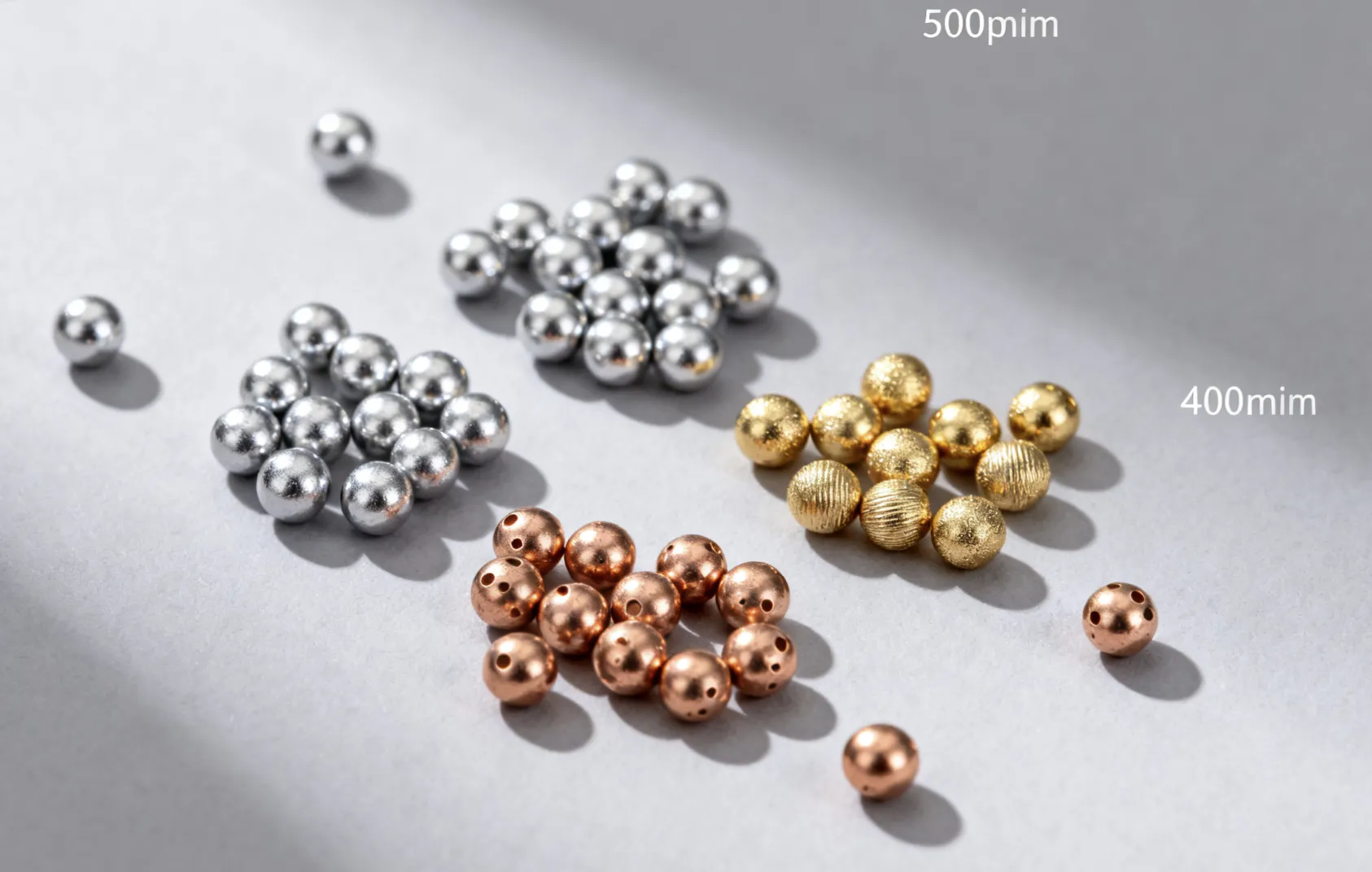
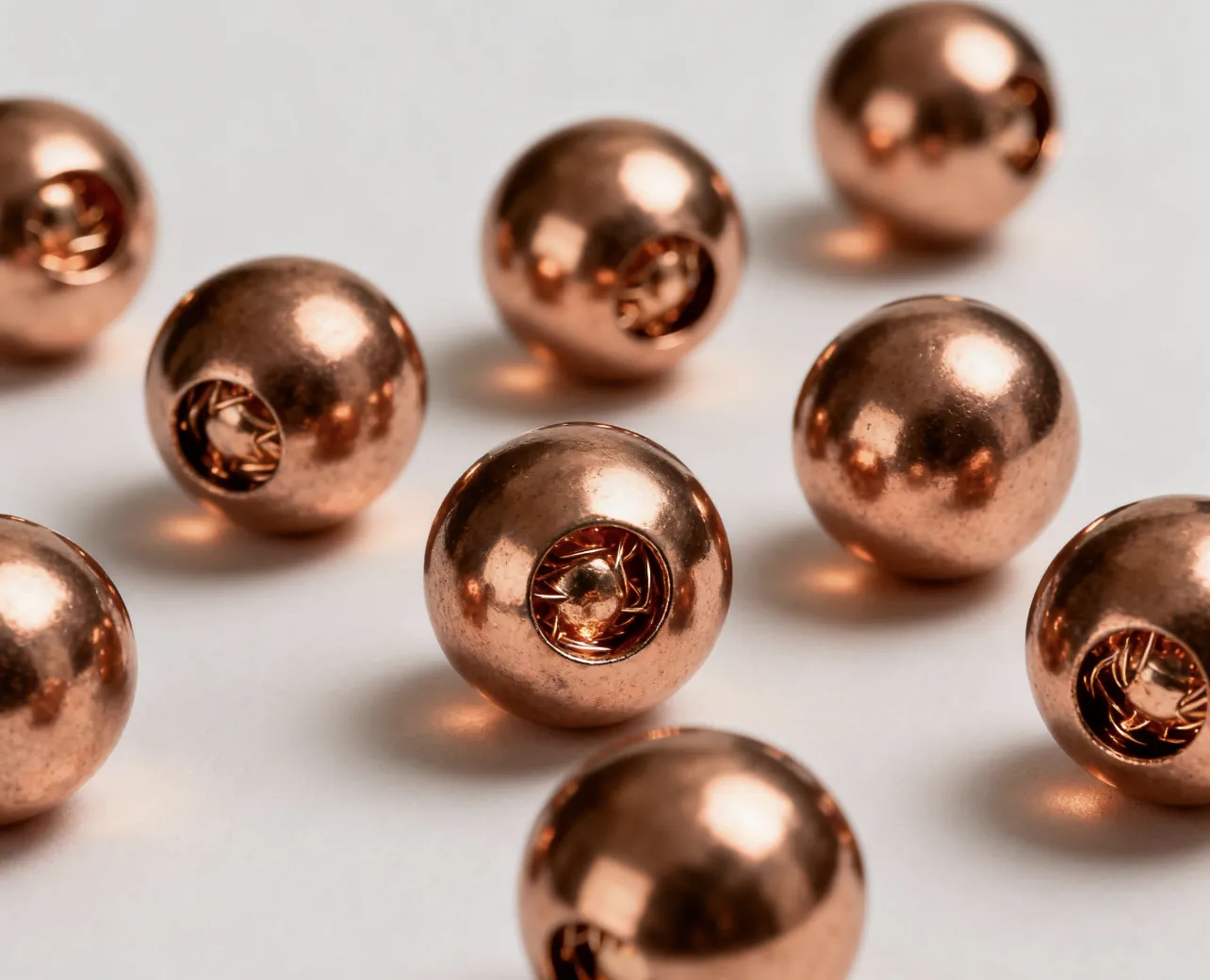
Copper core solder balls (CCSB), featuring a solid copper sphere coated with solder alloy (typically SAC-based), address many of these limitations by providing a rigid core that maintains stand-off height and enhances mechanical stability. This article compares the two types across four critical dimensions: thermal fatigue, stand-off height stability, shock/vibration resistance, and long-term reliability, supported by industry research and testing data.
1. Thermal Fatigue Resistance
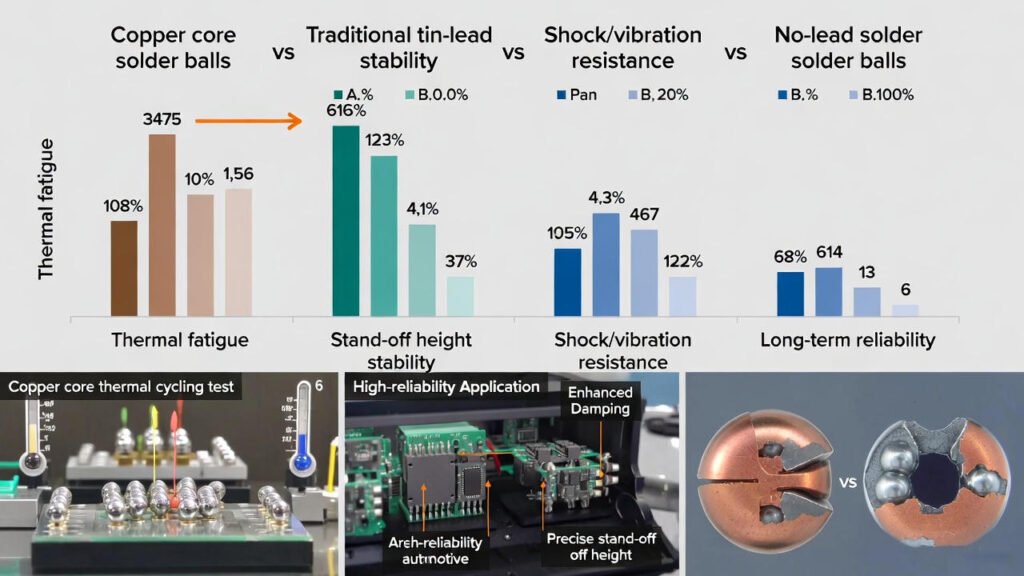
Thermal fatigue arises from coefficient of thermal expansion (CTE) mismatches between components and PCBs, leading to cyclic strain and eventual cracking.
- Traditional solder balls (e.g., SAC305): Rely entirely on the solder matrix for compliance. Under harsh thermal cycling (-55°C to +150°C or similar), they exhibit significant plastic deformation, IMC growth, and voiding, resulting in earlier failures.
- Copper core solder balls: The copper core (high melting point >1000°C) remains rigid during reflow and cycling, reducing overall strain in the solder layer. Studies show CCSB joints achieve 15-20% higher cycle life than SAC305 under equivalent conditions (e.g., JESD22-A104 thermal shock tests). In one analysis, CCSB/OSP joints survived 1.15-1.16 times more cycles than SAC/OSP equivalents due to lower plastic strain accumulation.
Advantage: Copper core significantly improves thermal fatigue life in multi-reflow and extreme temperature applications.
2. Stand-Off Height Stability (BLT Control)
Stand-off height (distance between package and board) is crucial for coplanarity, warpage tolerance, and stress distribution.
- Traditional solder balls: Collapse during reflow, especially in large packages or multi-reflow processes, leading to tilting, bridging, or inconsistent height.
- Copper core solder balls: The non-collapsible copper core acts as a spacer, maintaining precise stand-off height even after multiple reflows. This prevents collapse and ensures uniform joint geometry.
Advantage: Superior for high-density, fine-pitch assemblies and 3D/heterogeneous integration where height consistency is critical.
3. Shock and Vibration Resistance (Anti-Vibration/Anti-Shock)
High-reliability applications expose assemblies to mechanical shock and vibration.
- Traditional solder balls: Higher strain rates can cause brittle fractures, especially in SAC alloys with elevated Ag content.
- Copper core solder balls: The rigid core distributes stress more evenly and provides better damping. Combined with compliant solder coating, they offer enhanced drop and vibration performance.
Advantage: Ideal for aerospace and automotive environments where shock resistance is paramount.
4. Long-Term Reliability and Multi-Reflow Performance
Long-term reliability encompasses electromigration, voiding, and aging effects.
- Traditional solder balls: Prone to Kirkendall voiding, excessive IMC growth, and degradation after repeated reflows.
- Copper core solder balls: Lower overall CTE, better heat dissipation, and reduced electromigration risk due to the copper core. They excel in multi-reflow scenarios (common in rework or double-sided assembly) without compromising joint integrity.
Advantage: Proven in high-reliability sectors for extended service life.
Summary Comparison Table
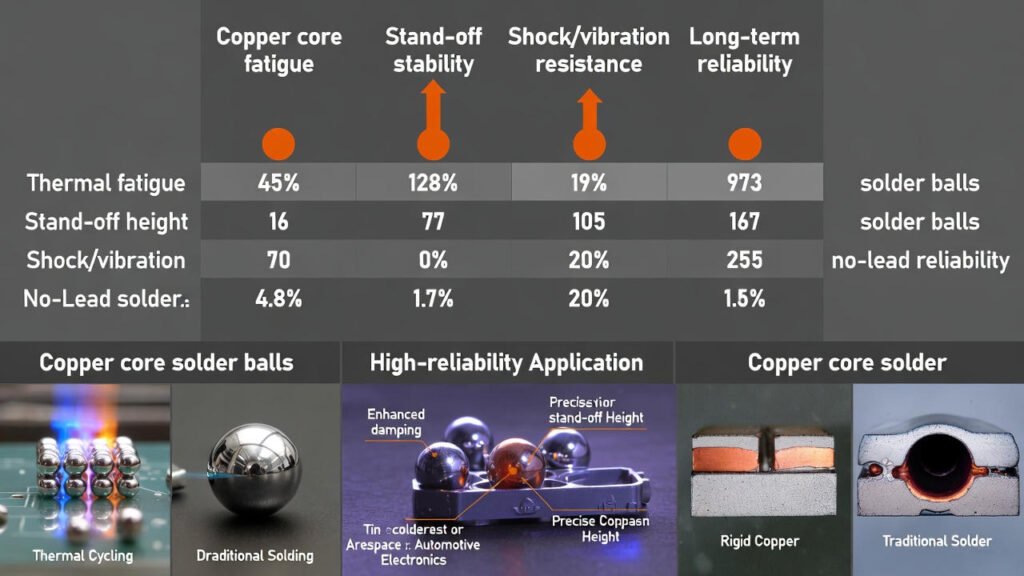
| Dimension | Traditional Solder Balls (SnPb / SAC) | Copper Core Solder Balls (CCSB) | Key Benefit for High-Reliability |
|---|---|---|---|
| Thermal Fatigue | Moderate (good in consumer use) | Superior (15-20%+ cycle life) | Extended life in harsh cycling |
| Stand-Off Height | Collapses during reflow | Maintains precise height | Prevents tilt/bridging in large packages |
| Shock/Vibration | Adequate for low-stress | Enhanced damping & strength | Better for aerospace/automotive |
| Long-Term Reliability | Good, but degrades with multi-reflow | Excellent, low voiding | Ideal for mission-critical apps |
Conclusion: When to Choose Copper Core Solder Balls
For standard consumer electronics, traditional SAC alloys suffice. However, in high-reliability applications—aerospace avionics, military radar, automotive under-hood modules, or satellite systems—copper core solder balls provide measurable improvements in reliability, reducing field failures and qualification costs.
At BGA Sphere, we manufacture precision copper core solder balls with customizable alloys, tight tolerances, and advanced anti-oxidation coatings. Our products are backed by extensive reliability testing and are designed specifically for multi-reflow and extreme environments.
Considering copper core solder balls for your next high-reliability project?
Contact our technical experts for free samples, custom alloy recommendations, or a full reliability consultation. Let us help you achieve zero-defect performance.
Contact Us | Request Samples | View Our Copper Core Solder Balls